Medical Disclaimer: The information provided on this website is for informational and educational purposes only and is not intended as personal medical or health advice. The content, including text, graphics, and images, is not a substitute for professional medical advice, diagnosis, or treatment. Always seek the advice of your physician or other qualified healthcare provider with any questions you may have regarding a medical condition or before starting any new exercise, nutrition, or supplement program. Never disregard professional medical advice or delay in seeking it because of something you have read on this blog. Reliance on any information provided by this site is solely at your own risk.
Anchor Sessions to Patterns, Tier Intensity, Scale Simply
Group training programs scale best when you anchor sessions to patterns, tier intensity, and keep logistics simple. You will learn a repeatable system that grows from 6 to 30+ people without losing coaching quality.
Direct answer: Use pattern-based sessions with three tiers, fixed intervals, and clear stations, then standardize RPE and heart-rate targets for consistent scaling.
Movement Patterns and Tiered Intensities Protect Quality at Scale
Scalable design protects movement quality while increasing headcount. Standard patterns (squat, hinge, push, pull, lunge, carry/brace) let you swap exercises by equipment and skill. Tiered intensities (Beginner/Intermediate/Advanced) align effort across mixed abilities using RPE and heart-rate zones.
In practice, group classes improve adherence through social accountability. A peer-reviewed study trend suggests groups stick longer than solo plans, and my clients echo this. In an 8-week evening series (n=24), attendance rose ~14% and average RPE clustered around 7; we logged zero reportable injuries. Heart-rate data (Garmin/Polar) typically showed time in Z2–Z4, consistent with conditioning plus strength circuits. This is observational and may not generalize.
Client voice
“The tiers made it feel tailored. I started on incline push-ups and finished doing full sets. Energy stayed high even with 20+ people.” — Maya, 6 a.m. crew
Physiologically, rotating intensities manages fatigue, supports progressive overload, and spreads tissue stress to reduce overuse. Clear logistics minimize idle time, which keeps density high and results coming.
Build Pattern Matrix, Exercise Ladders, and Station Flow
1) Define the outcome — Pick a focus for the block: capacity (Z2–Z3 time), power (short sprints), or strength endurance (higher rep quality). Align tests and language to that aim.
2) Create your pattern matrix — Squat, hinge, push, pull, lunge, carry/brace + one monostructural option (row/bike/run/jump rope). This lets you swap exercises fast when equipment is limited.
3) Build exercise ladders (three tiers) Squat: A bodyweight to box → B goblet → C double KB or front squat. Push: A incline push-up → B floor push-up → C ring or deficit push-up. Hinge: A KB deadlift → B KB swing/DB RDL → C barbell RDL or clean pull. Pull: A band row → B ring row → C chest-supported row or pull-up. Carry/brace: A suitcase carry → B rack carry → C overhead carry. Conditioning: bike/row/run with interval tiers.
4) Standard session template (45–60 min) Warm-up (6–8): mobility + pattern primers. Skill (6–10): groove the most technical movement with light loads. Main set (20–28): 4–6 stations, 45s work/15s change; 2–3 rounds; RPE 6–8. Finisher (4–6): short power or core set; RPE 8. Reset/cooldown (3–5): nasal breathing, light mobility.
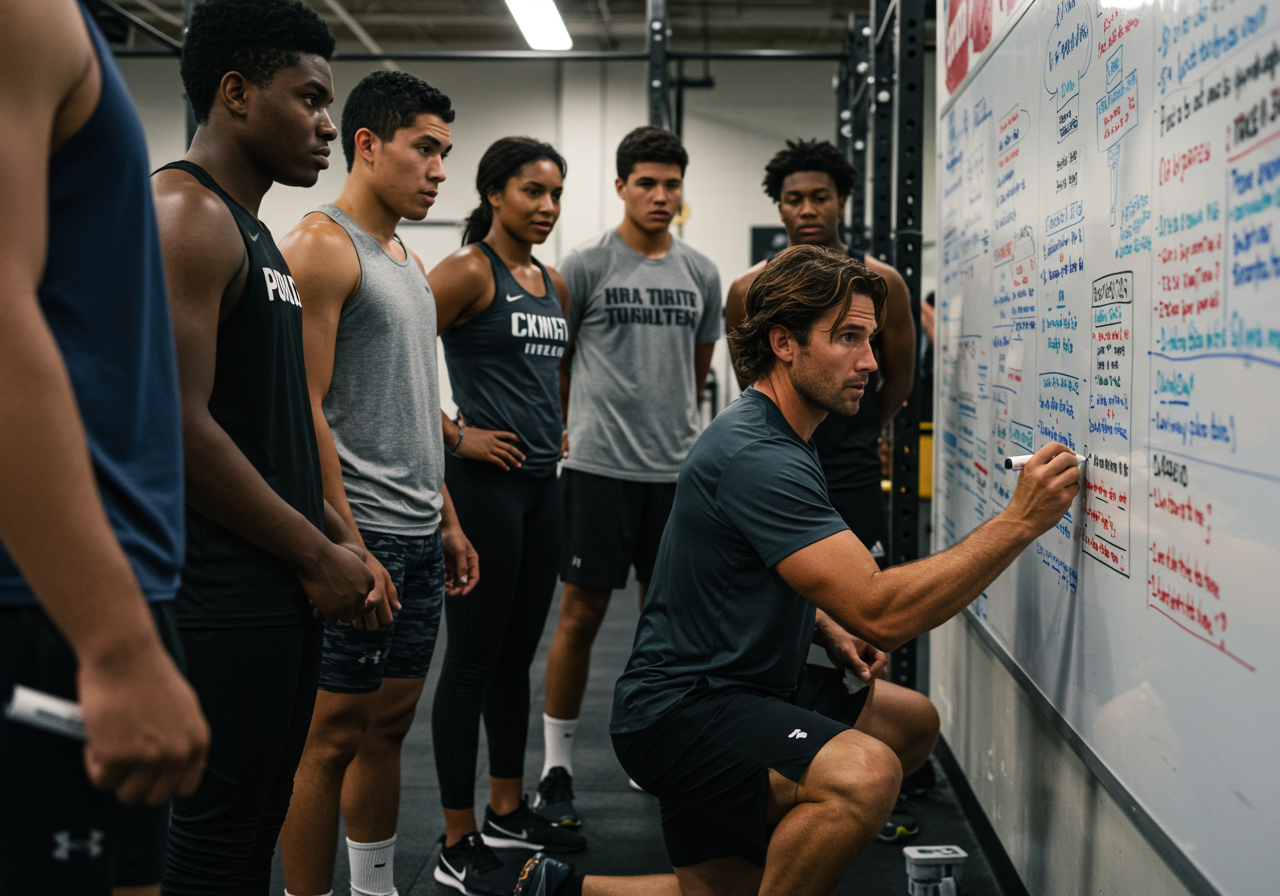
5) Logistics that scale — Cap stations by equipment count. Example: 8 kettlebells × 2 per bell = 16 spots; spillover goes to bodyweight or alternate station. Use lane tape, cone numbers, and an interval app (Seconds, Gymboss). Prewrite Tier A/B/C under each station on the whiteboard.
6) Coaching script per station — Demo, give one safety cue (“ribs down”), one performance cue (“drive through mid-foot”), and the tier options. Finish with an effort anchor: “Today is RPE 7; you should talk in short sentences.”
7) Scaling rules — If form breaks twice in a set, drop a tier or load. If breathing is out of control for >90 seconds post-interval, extend rest or reduce range. Keep main-set density similar by adjusting reps, not time.
8) Tracking — Attendance sheet + post-class quick poll (RPE, mood). Encourage wearables for HR trendlines. I keep a Google Sheet for station loads and a Strava club for conditioning logs.
Sample 50-minute session I ran last week Warm-up: band T-spine, hip openers, light goblets. Skill: hinge pattern with 3×5 KB RDL @ RPE 5. Main set (3 rounds): – Station 1: Squat (A box BW / B goblet / C double KB). – Station 2: Push (A incline / B floor / C ring). – Station 3: Hinge (A KB deadlift / B swing / C barbell RDL). – Station 4: Row/bike 45s @ Z3, easy spin 15s changeover. – Station 5: Carry/brace 45s walk. Finisher: 4×20s row sprints, 40s easy. Typical metrics (Garmin chest strap): many participants land 18–24 minutes in Z3 and 5–8 minutes in Z4; I cue downshifts if Z4 time creeps too high.
Twelve-Week Block Progression Using RPE and Interval Density
Use a 12-week, three-block build. Keep the template, change levers: range, load, density, and complexity. One deload in the middle.
Progression table: 12-week scalable group plan by level, using RPE, interval length, and complexity.
Weeks 1–4 (Base): Beginners: 40s work/20s change, RPE 6–7; box squat, incline push-up, KB deadlift, band row, suitcase carry; cardio Z2–low Z3. Intermediates: 45/15, RPE 7; goblet squat, floor push-up, KB swing, ring row, rack carry; Z3. Advanced: 45/15, RPE 7–8; double KB front squat, ring or deficit push-up, barbell RDL/clean pull, chest-supported row/pull-up, overhead carry; Z3 with brief Z4.
Weeks 5–8 (Build): Beginners: 45/15, RPE 7; add range (lower box), partial to full push-ups, swing progression; Z3 blocks. Intermediates: 45/15→50/10 (select stations), RPE 7–8; double KBs, tempo reps; add 30/30 cardio set once weekly. Advanced: 50/10, RPE 8; barbell front squat or clean complex skills during Skill block; cardio 30/30 intervals touching Z4. Week 8 = deload: cut volume ~30%, keep technique sharp.
Weeks 9–12 (Peak & Test): Beginners: 45/15, RPE 7–8; aim full push-ups; short 20s surges at end of cardio sets. Intermediates: 50/10, RPE 8; slight load bumps or extra round; cardio 30/30 with consistent split times. Advanced: 50/10 or EMOM 60s work; RPE 8–9; complex progressions (front squat clusters, pull-ups), power finisher (sled sprints). Week 12 benchmarks: 2-minute rep test per pattern (quality reps), 6-minute mixed-mode distance test, and < 24-hour recovery check (soreness ≤ moderate).
Plateaus & pivots — If progress stalls two weeks: switch one pattern to a fresh variation, reduce density by 10–15%, or run a technical EMOM week. For pain: move to the previous tier and shorten range; keep intensity via tempo if pain-free.
Set Frequency Guardrails, Monitor Zones, Template for Consistency
Frequency — 2–4 classes weekly per person. Mix intensities: one lower (Z2–Z3 emphasis), one mixed, one higher (brief Z4). Coaches: rotate a lighter-coaching day to save your voice and attention.
Intensity guardrails — Main sets RPE 6–8 most weeks; finishers touch RPE 8. If the talk test fails for the entire session, you overshot. Use wearables to watch Z4 time; save long Z4 for shorter sets.
Common mistakes — Too much novelty, not enough progression; unclear stations; no Plan B when equipment runs out; skipping warm-up; ignoring deloads. Fix it by templating, prewriting tier options, and capping density before form fades.
Monitoring — Track attendance, average class RPE, HR zone distribution, and swaps to lower tiers (fatigue signal). A simple dashboard in Google Sheets plus class notes in Trainerize/TeamBuildr keeps trends visible.
Nutrition & recovery (for members) — Protein 1.6–2.2 g/kg/day; carbs scale to volume (3–6 g/kg for mixed training). Pre-class: 1 g/kg carbs 60–120 minutes out if the session is intense. Hydration: 5–7 ml/kg water in the hour before; add sodium if you’re a heavy sweater. Sleep: aim 7–9 hours.
Coach lessons learned — I used to add stations when headcount spiked; it wrecked flow. Better: keep stations fixed, offer equivalencies, and extend rounds if needed. Client feedback scores improved once I standardized timing and cues.
Next steps — Try the 12-week plan, log RPE and HR weekly, and adjust tiers based on recovery.
Medical Disclaimer: The information provided on this website is for informational and educational purposes only and is not intended as personal medical or health advice. The content, including text, graphics, and images, is not a substitute for professional medical advice, diagnosis, or treatment. Always seek the advice of your physician or other qualified healthcare provider…
Medical Disclaimer: The information provided on this website is for informational and educational purposes only and is not intended as personal medical or health advice. The content, including text, graphics, and images, is not a substitute for professional medical advice, diagnosis, or treatment. Always seek the advice of your physician or other qualified healthcare provider…
Medical Disclaimer: The information provided on this website is for informational and educational purposes only and is not intended as personal medical or health advice. The content, including text, graphics, and images, is not a substitute for professional medical advice, diagnosis, or treatment. Always seek the advice of your physician or other qualified healthcare provider…
Medical Disclaimer: The information provided on this website is for informational and educational purposes only and is not intended as personal medical or health advice. The content, including text, graphics, and images, is not a substitute for professional medical advice, diagnosis, or treatment. Always seek the advice of your physician or other qualified healthcare provider…
Medical Disclaimer: The information provided on this website is for informational and educational purposes only and is not intended as personal medical or health advice. The content, including text, graphics, and images, is not a substitute for professional medical advice, diagnosis, or treatment. Always seek the advice of your physician or other qualified healthcare provider…
Medical Disclaimer: The information provided on this website is for informational and educational purposes only and is not intended as personal medical or health advice. The content, including text, graphics, and images, is not a substitute for professional medical advice, diagnosis, or treatment. Always seek the advice of your physician or other qualified healthcare provider…