Medical Disclaimer: The information provided on this website is for informational and educational purposes only and is not intended as personal medical or health advice. The content, including text, graphics, and images, is not a substitute for professional medical advice, diagnosis, or treatment. Always seek the advice of your physician or other qualified healthcare provider with any questions you may have regarding a medical condition or before starting any new exercise, nutrition, or supplement program. Never disregard professional medical advice or delay in seeking it because of something you have read on this blog. Reliance on any information provided by this site is solely at your own risk.
Start Smart: Essential Equipment and Training Framework
Home gym setup can be affordable, effective, and complete when you follow a simple system. This guide shows equipment picks and a full training plan.
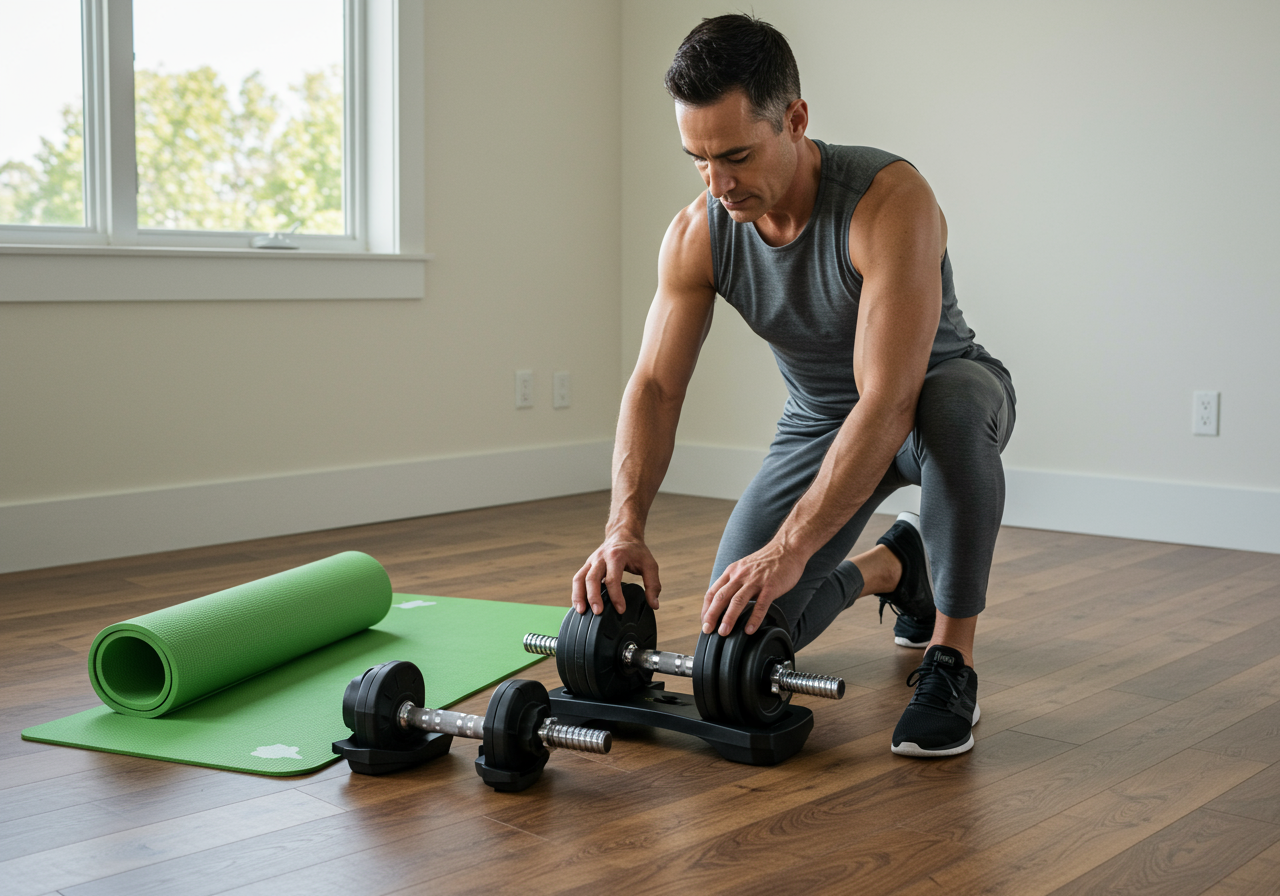
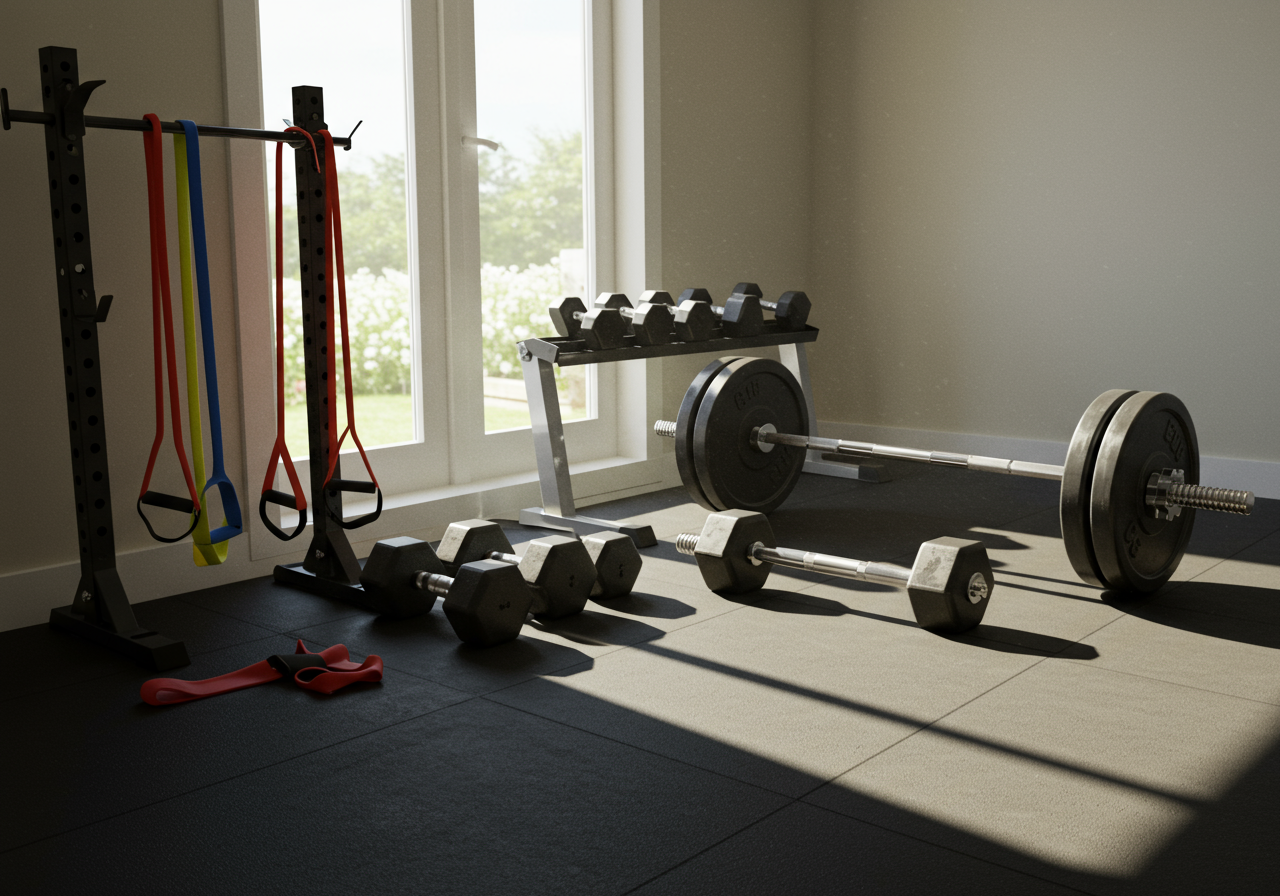
Direct answer: Start with a mat, adjustable dumbbells, and a timer; add bands, a bench, and a pull-up option as budget grows.
You will learn how to build a balanced routine—cardio, strength, mobility, and skills—then scale from beginner to advanced while tracking progress and avoiding common pitfalls.
Science-Backed Benefits of Consistent Home Training
Convenient access increases adherence. A home setup removes commute friction, helping you hit weekly strength volume and aerobic minutes consistently—two drivers of fitness and body composition change.
Physiology in brief: Strength improves by progressive overload and sufficient protein/sleep. Cardio enhances stroke volume and mitochondrial capacity (steady Zone 2 plus short intervals). Mobility preserves joint range and tissue tolerance, lowering overuse risk.
In practice and in peer‑reviewed guidance, people who train 3–5 days/week with a structured plan see steady strength increases and improved endurance over 8–12 weeks, provided recovery and nutrition are aligned.
My coaching experience mirrors this: simple tools (bands, adjustable dumbbells, a pull-up option) deliver most of the return when paired with deliberate programming and honest tracking.
Budget-Tiered Equipment Guide and Space Setup
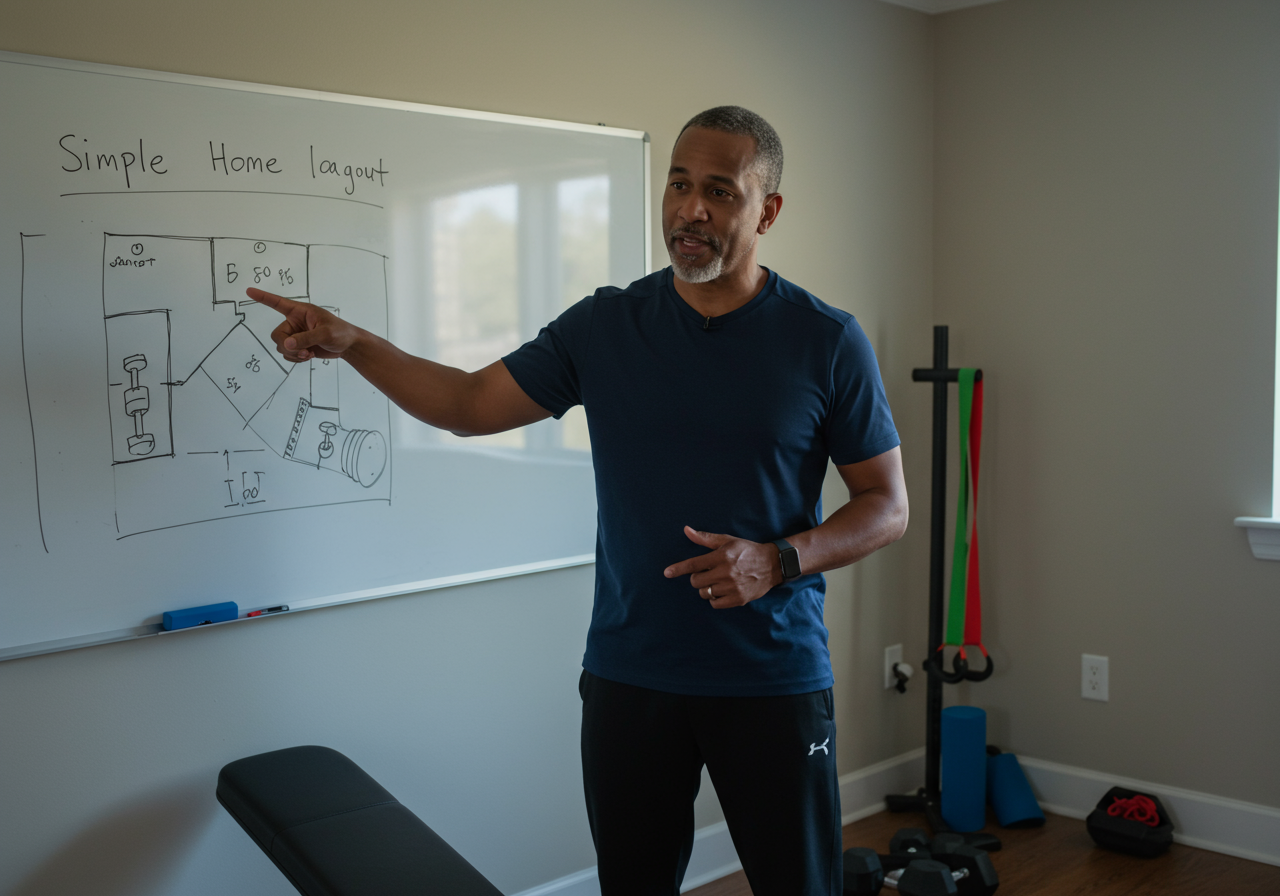
Step 1 — Measure and plan the space. Clear a 6×6 ft area. Add a mat for traction and noise control. Leave headroom for overhead presses and a pull-up option. A fan and good lighting help.
Full-Body A (35–45 min) Warm-up — 5 min easy rope or marching + dynamic hips/shoulders. 1) Goblet squat 3×8–12 @ RPE 7–8 2) One-arm row (DB/band) 3×10–12 @ RPE 7 3) Push-up or DB floor press 3×6–10 @ RPE 7–8 4) Hip hinge (DB RDL) 3×8–12 @ RPE 7–8 5) Carry (suitcase or farmer) 3×30–60 m
Full-Body B (35–45 min) Warm-up — 5 min brisk walk + T-spine rotations. 1) Split squat 3×8–12/leg @ RPE 7–8 2) Pull-up/assisted or band pulldown 3×AMRAP leaving 1–2 reps in reserve 3) Overhead press (DB) 3×6–10 @ RPE 7–8 4) Hip thrust or bridge 3×10–15 @ RPE 7 5) Core: dead bug or side plank 3×30–45 s
Cardio options • Zone 2: 20–45 min brisk walking with hills, rower, or air bike. You should speak in full sentences. • Intervals: 6–10 rounds of 40 s strong / 80 s easy. Keep last two rounds challenging but controlled.
Mobility micro-flow (6–8 min) 90/90 hips (slow switches), ankle rocks, thoracic open books, band dislocates, couch stretch.
Step 5 — Track and adjust. Use apps: Strong/Trainerize or a Google Sheet for sets, reps, RPE; Strava or Garmin/Coros for cardio; MyFitnessPal or Cronometer for nutrition; Fitbit or Oura/Whoop for sleep trends. Note morning energy and soreness (0–10). Adjust volume if average soreness >4 for 3 days.
Nutrition & recovery basics. Aim for protein ~1.6–2.2 g/kg/day, 7–9 hours of sleep, and 2–3 servings of fruits/veggies daily. Hydrate: clear urine by midday. Creatine monohydrate 3–5 g/day is widely supported and inexpensive. If fat loss is a goal, trial a ~300 kcal daily deficit while preserving strength performance.
Mistakes I see (and fixed). Overbuying before building habits, skipping flooring, ignoring pull strength, turning every session into a max-out, and never logging RPE. The cure: start small, bias pulls, log every set, and keep two easy days weekly.
“I set up a $250 corner—bands, mat, adjustable dumbbells, and a doorframe bar. Three months later I’m training four days/week without missing. The structure beat my old ‘motivation’ approach.” — Maya, remote client
Structured 12-Week Progression for All Levels
How to progress: Add reps first, then load, or add a set. Keep 1–3 reps in reserve on most sets. For cardio, extend Zone 2 time before increasing interval intensity.
Upgrade path: As lifts approach 12–15 reps with ease, step up to heavier dumbbells or add a kettlebell. When rows and presses outgrow dumbbells, consider a rack + barbell.
8–12 Week Roadmap
Progression overview — adjust by RPE and recovery.
Week 1–2: 3 days strength (3×8–10 @ RPE 6–7), 2–3 Zone 2 (20–30 min), 1 mobility daily

Week 3–4: 3–4 days strength (add 1 set to main lifts), Zone 2 (30–40 min), 6×40/80 intervals

Week 5: Deload strength (reduce sets by 30–40%), maintain cardio volume easy

Week 6–7: 4 days strength (top sets @ RPE 8–9), Zone 2 (35–45 min), 8×40/80 intervals

Week 8: Reps PR week (aim +1–2 reps per set), test AMRAP push-ups & 1-mile easy time

Week 9–10 (Intermediate): 4 days strength split (2 heavy, 2 pump), Zone 2 2×40–50 min, 10×40/80

Week 11: Deload (drop intensity; technique focus, long walks)

Week 12 (Advanced taste): Heavy triples on two lifts @ RPE 8; longer Zone 2 (50–60 min) or tempo run/ride
Beginner cues: Stop 2–3 reps shy of failure. Focus on consistent form and full ROM. Keep intervals strong, not frantic.
Intermediate cues: Wave sets (e.g., 3×6 heavy, 1×12 back-off). Use supersets for efficiency. Track weekly tonnage.
Advanced cues: Rotate special variations (front squat, deficit RDL). Use 4-week blocks with a planned deload. For cardio, add threshold intervals (e.g., 3×8 min comfortably hard with 3–4 min easy).
Validation checks: Every 4 weeks, compare: resting HR trend, 1–3 rep PRs or rep PRs at same load, push-up AMRAP, and a steady-state pace at the same HR. In coaching practice, these markers reliably show progress when recovery is intact.
References & Further Reading
The following peer-reviewed research and authoritative guidelines support the recommendations in this article:
Frequency & intensity: Most do well with 3–5 training days. Keep two easy days weekly. Strength lives mostly at RPE 6–8. Intervals should finish with 1–2 reps in reserve feeling.
Form & setup: Anchor bands securely. Use safeties when barbell squatting or benching solo. Wear stable shoes for heavy hinges and squats.
Plateaus: Try a back-off set (high reps), swap a variation (e.g., incline press), or add 10–20% more weekly volume for 2–3 weeks. For cardio, increase Zone 2 minutes by 10–15% before re-adding intensity.
Overtraining signs: Persistently elevated morning HR, poor sleep, irritable mood, declining performance. Response: deload for 5–7 days and prioritize carbs, hydration, and 8–9 hours of sleep.
Injury considerations: Pain that sharpens with each set or lingers beyond 48 hours merits a step back or professional evaluation. Adjust ROM and tempo; do not chase numbers on bad days.
Nutrition nudges: Distribute protein across 3–5 meals, include carbs pre-lift (banana + yogurt works), and add a salty drink for hot garages. Caffeine 30–45 minutes pre-workout can help, but cycle it occasionally.
Next steps: Start with the Core budget list, run Weeks 1–4, and track everything. If you found this useful.
Medical Disclaimer: The information provided on this website is for informational and educational purposes only and is not intended as personal medical or health advice. The content, including text, graphics, and images, is not a substitute for professional medical advice, diagnosis, or treatment. Always seek the advice of your physician or other qualified healthcare provider…
Medical Disclaimer: The information provided on this website is for informational and educational purposes only and is not intended as personal medical or health advice. The content, including text, graphics, and images, is not a substitute for professional medical advice, diagnosis, or treatment. Always seek the advice of your physician or other qualified healthcare provider…
Medical Disclaimer: The information provided on this website is for informational and educational purposes only and is not intended as personal medical or health advice. The content, including text, graphics, and images, is not a substitute for professional medical advice, diagnosis, or treatment. Always seek the advice of your physician or other qualified healthcare provider…
Medical Disclaimer: The information provided on this website is for informational and educational purposes only and is not intended as personal medical or health advice. The content, including text, graphics, and images, is not a substitute for professional medical advice, diagnosis, or treatment. Always seek the advice of your physician or other qualified healthcare provider…
Medical Disclaimer: The information provided on this website is for informational and educational purposes only and is not intended as personal medical or health advice. The content, including text, graphics, and images, is not a substitute for professional medical advice, diagnosis, or treatment. Always seek the advice of your physician or other qualified healthcare provider…
Medical Disclaimer: The information provided on this website is for informational and educational purposes only and is not intended as personal medical or health advice. The content, including text, graphics, and images, is not a substitute for professional medical advice, diagnosis, or treatment. Always seek the advice of your physician or other qualified healthcare provider…