How to break through a strength plateau starts with a clear plan that adjusts volume, recovery, and technique without guessing. You will learn a simple system that gets lifts moving again.
Direct answer: Deload briefly, then raise weekly hard sets 10–20% while improving sleep and technique to restart progress.
Why Plateaus Occur and Recovery Science Matters
Plateaus happen when your body adapts to a stable stress. Muscles, tendons, and your nervous system need a fresh stimulus that you can still recover from. The sweet spot lives between undertraining (no signal) and overload (too much fatigue).
Peer-reviewed work suggests two levers dominate progress: sufficient volume across the week and progressive intensity, supported by sleep and nutrition. In coaching logs and practice reports, lifters often resume personal records within 4–6 weeks after a deload plus small volume increases, provided technique improves and recovery habits tighten. Cardio at low intensity can also speed recovery by improving blood flow without stealing strength when managed well.
Six Tactics Including Volume Audit and Tempo
Volume audit and add small doses. Log every hard set (RPE ≥7) per muscle/movement. If you average 8–10 hard sets/week for the stalled lift, add 2–4 sets spread over two sessions. Keep most sets in RPE 7–9. Example: Squat day A 3×5 @ RPE 7–8, day B 3×6 @ RPE 7, plus 2 sets of leg press @ RPE 8.
Undulate rep ranges and cycle intensity. Rotate stimulus within the week: one heavy day (3–5 reps), one moderate day (6–8), one volume or speed day (8–12 or 2–3 reps with 60–70% focusing on bar speed). This keeps progression moving without cooking your nervous system.
Technique tune-up and tempo. Record two angles of your main lift. Fix depth, bar path, and bracing. Add 2–3 weeks of tempo work (e.g., 3–0–1 squat) at lighter loads to groove positions. Use cues: “big breath to belt,” “drive mid-foot,” “finish with glutes.”
Target weak links. Add 1–2 accessories that attack the sticking point: for squats, pause squats or leg press; for bench, long‑pause bench or triceps extensions; for deadlift, RDLs or block pulls. Keep 6–10 total weekly sets for accessories, RPE 7–8.
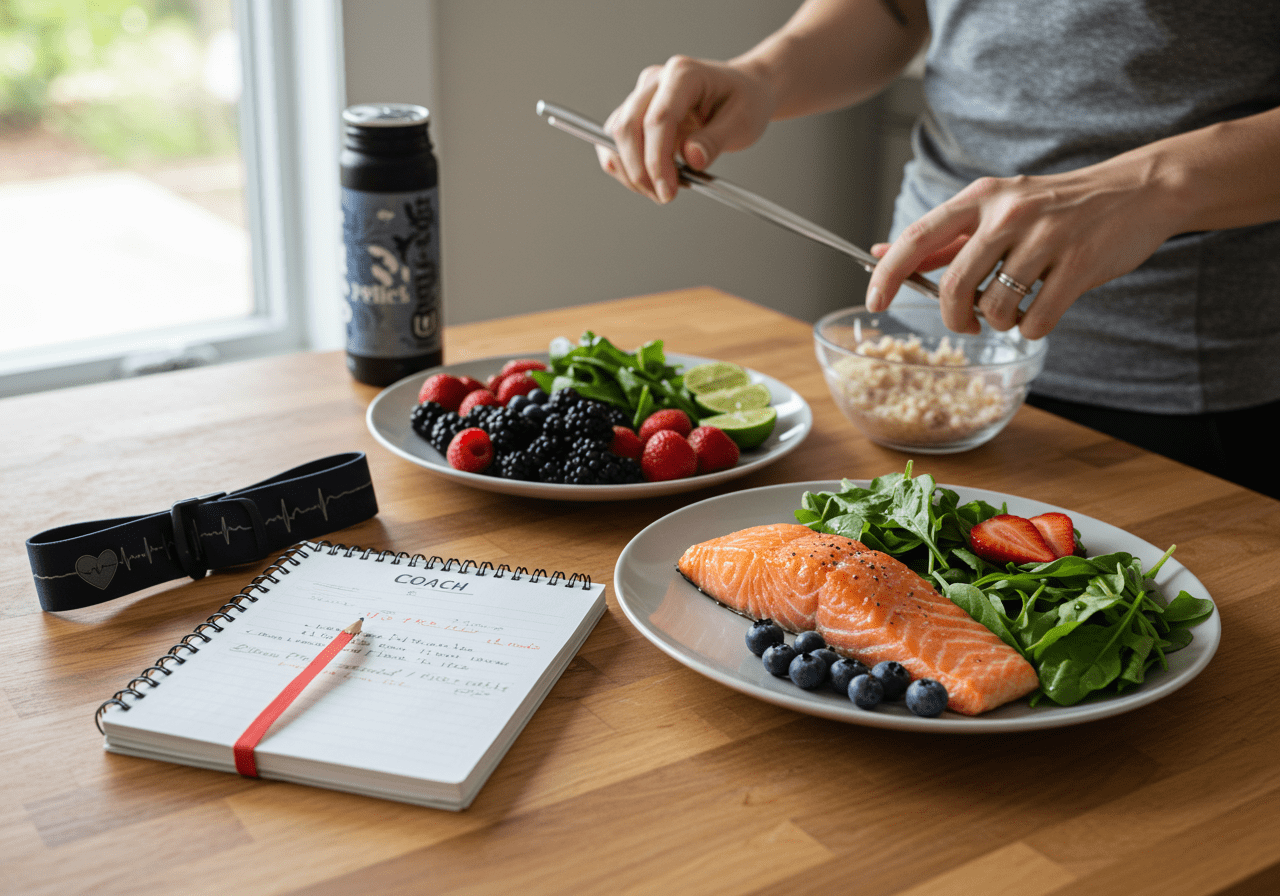
Recover harder than you train. Sleep 7.5–9 hours, protein 1.6–2.2 g/kg/day, and carbs around training (1–1.5 g/kg in the 3–6 hours post‑lift). Insert a deload every 4–8 weeks: drop volume by ~40–50% and intensity by ~5–10%. Low‑intensity cardio 20–30 min in Zone 2 once or twice weekly aids recovery without strength loss.
Microload and small variations. If jumps feel huge, add 0.5–1 kg per side or use fractional plates. Rotate close variations every 3–4 weeks (e.g., high‑bar to low‑bar, close‑grip to paused bench) to avoid staleness while keeping transfer high.
Sample session (intermediate squat, 60 minutes):
Warm-up — 5 min easy bike (Zone 1–2), hip openers, 2×10 bodyweight squats.
Cool‑down — Walk 5 min; diaphragmatic breathing 2 min.
Tools I use with clients: Garmin/Apple Watch for heart rate, Strong/RepCount for logging sets and RPE, MyFitnessPal for protein and carb timing, and a simple Google Sheet for weekly set counts.
Client note (shared with permission): “We deloaded one week, then added two back‑off sets on bench. Four weeks later my 5‑rep set moved from 60 kg to 64 kg—without shoulder pain.”
Eight-Week Template Scaling Beginner to Advanced
Use this eight‑week template to apply the tactics and scale difficulty safely. Test as suggested, then recycle.
Progress template: weekly structure for each level with sets, intensity, accessories, and recovery.
Beginner — 3 days/wk full-body, 60–70 min

Week 1 (Deload): Main lifts 2x5 @ RPE 6; accessories 1–2x10; Zone 2 walk 20 min 1x.

Week 2: Add +2 hard sets total; main 3x5 @ RPE 7; accessories 2x10 @ RPE 7.

Week 3: 3x5 heavy day; 3x6 moderate day; 2x8 volume day; Zone 2 20–25 min 1–2x.

Week 4: +2 sets (spread); microload 0.5–1 kg/side on main lift.

Week 5 (Light): Reduce volume ~30%; keep bar speed; mobility 10 min/session.

Week 6: Resume Week 4 loads; add 1 back-off set @ -10% load.

Week 7: Heavier triples on heavy day (4x3 @ RPE 8); keep moderate/volume days.

Week 8 (Test): Single @ RPE 8 then AMRAP set @ ~85% (cap at RPE 9); compare e1RM.


Intermediate — 4 days/wk upper/lower split, 70–85 min

Week 1 (Deload): 50% volume; technique/tempo focus; Zone 2 bike 25 min 2x.

Week 2: 10–15 hard sets per lift pattern/week; heavy 3–5, mod 6–8, volume 8–12.

Week 3: Add +2–3 accessory sets at RPE 7–8 for weak links.

Week 4: Microload each heavy day; pause reps 1–2/ set on bench/squat.

Week 5 (Pivot): Swap in close variation (e.g., paused deadlift) at 80–85% of normal load.

Week 6: Increase top set by smallest plate; maintain back-off volume.

Week 7: Heavy doubles (3–4x2 @ RPE 8–8.5); keep speed work.

Week 8 (Evaluation): e1RM from top single @ RPE 8; keep two reps in reserve on all else.


Advanced — 4–5 days/wk, 75–95 min

Week 1 (Deload): 40–50% less volume; maintain skill with lighter singles @ RPE 6–7.

Week 2: Heavy/Mod/Speed undulation; total weekly hard sets near prior best -10%.

Week 3: Match prior best weekly sets; push top set by microload only.

Week 4: Overshoot volume +10–15%; accessories for sticking point bias.

Week 5 (Recovery emphasis): Volume -30%; Zone 2 30 min 2x; sleep ≥8 h.

Week 6: Re‑add overshoot volume; top single @ RPE 8.

Week 7: Specific overreach: add 1 set to heavy and volume days; RPE cap 9.

Week 8 (Assess & Rotate): Compare e1RM, bar speed; rotate to new close variation.
Validation checkpoints: Track estimated 1RM (top single @ RPE 8), bar speed if available, and total weekly hard sets. A modest rise in e1RM or more reps at the same load indicates progress.
Frequency, Nutrition, Cardio, and Common Mistakes
Frequency: Beginners 3 days/week; intermediates 4; advanced 4–5. Keep most work at RPE 7–9. If bar speed craters or joints ache for 3+ sessions, deload early.
Nutrition and recovery: Protein 1.6–2.2 g/kg/day. Distribute carbs around training to support volume. Hydrate to pale straw urine. Consider creatine monohydrate 3–5 g/day if tolerated; consult a professional if you have medical concerns. Aim for consistent 7.5–9 hours of sleep.
Cardio for recovery: One to two Zone 2 sessions (20–30 minutes) weekly. Keep them away from heavy lower‑body days when possible. I track heart rate with Garmin and export to Strava; most clients recover fine when they keep cardio easy.
Common mistakes: Chasing PRs weekly, skipping deloads, adding too many accessories at once, poor bracing, and inconsistent logging. Use a simple sheet with columns: date, exercise, sets×reps×load, RPE, notes. Trend e1RM and total weekly hard sets.
Safety: Distinguish effort from pain. Sharp or radiating pain, numbness, or joint instability warrants stopping and seeking a qualified clinician. Warm up with gradual load jumps and practice your setup every set.
Next steps: Download my free set‑count tracker (Google Sheet) and copy the eight‑week template. If you want coaching eyes, send your lift videos and log via Drive—happy to review.
Build Sustainable Speed with Weekly Threshold Sessions Tempo runs are my most reliable tool for lifting sustained race pace without feeling wrecked. If you’re new to structured training, this guide shows you exactly how to build, progress, and measure tempos for safer, faster results. Direct answer: Run 15–30 minutes at comfortably hard threshold once weekly,…
Strength training for older adults builds confidence, mobility, and independence when progressed gradually and performed with good form. The safest plan uses simple exercises, pain-free ranges, and steady load increases. In the next few minutes you will learn a complete system: joint-friendly exercise choices, clear weekly progressions, safety cues, recovery habits, and how to confirm…
Mobility drills prepare joints for better performance Mobility warm-up sets your joints and nervous system for better movement, strength, and cardio performance. Quick answer: pair short mobility drills with activation, then rehearse the day’s pattern. In a few minutes, you will learn an easy sequence I use with new clients: breathing reset, joint prep, mobility–activation…
Master lactate threshold testing and zone-based training systems Lactate threshold is the anchor metric you’ll use to pace, build endurance, and recover smarter. Here you’ll learn how to test it, interpret it, and train around it. Lactate threshold is the fastest steady pace you can hold for 30–60 minutes; train slightly below and just above…
Restore T-Spine Extension for Pain-Free Overhead Lifts Thoracic mobility is the hinge that unlocks safe, powerful overhead lifts. In minutes per day, you can restore extension and rotation and protect your shoulders. Quick answer: Combine breath-led drills, end-range loading, and clean scapular mechanics practiced daily for 8–12 minutes. You’ll learn how to assess your T‑spine,…
Start Strong Cycling Workout Plan for Endurance and Power Gains: here’s a simple path to ride longer, push harder, and recover better. Direct answer: Do 3–5 rides weekly—2 base, 1 threshold, 1 power/sprints, plus optional skills; progress volume or intensity every week. In this guide you’ll learn the exact ride types, how to set zones…