Strength training for older adults builds confidence, mobility, and independence when progressed gradually and performed with good form. The safest plan uses simple exercises, pain-free ranges, and steady load increases.
In the next few minutes you will learn a complete system: joint-friendly exercise choices, clear weekly progressions, safety cues, recovery habits, and how to confirm that your training is working.
Age-related losses in muscle and power are real, but trainable. Strength work can support bone density, improve balance, and make daily tasks easier. Tendons and connective tissue adapt more slowly with age, so controlled tempo and adequate recovery reduce irritation while still stimulating progress. In peer-reviewed research and practice, two to three full-body sessions per week improve function and self-efficacy in older adults.
From my coaching notes: Marta (68) improved her 30-second sit-to-stand from 10 to 17 reps over 8 weeks while reporting less knee discomfort. Tom (72) moved from a 16 kg to a 24 kg suitcase carry for 30 meters, feeling steadier on stairs. These are single-client outcomes, but they mirror what larger practice reviews report.
What finally clicks is consistency and simple metrics. We track session RPE, a few functional tests, and whether stairs, groceries, and hobbies feel easier. If a joint complains, we modify the range, switch the implement, or adjust volume before changing the goal.
Warm-up — 5–8 minutes: Easy movement that raises body temperature without fatigue. Example: 3 minutes brisk walk or recumbent bike, then gentle ankle rocks, shoulder circles, and 10 cat-camels.
Movement prep — 3 minutes: Practice the patterns you will train. Example: box sit-to-stand x 8, dowel hip hinge x 8, wall push-up x 8, band row x 12.
Main session (2–3 sets each, RPE 5–7):
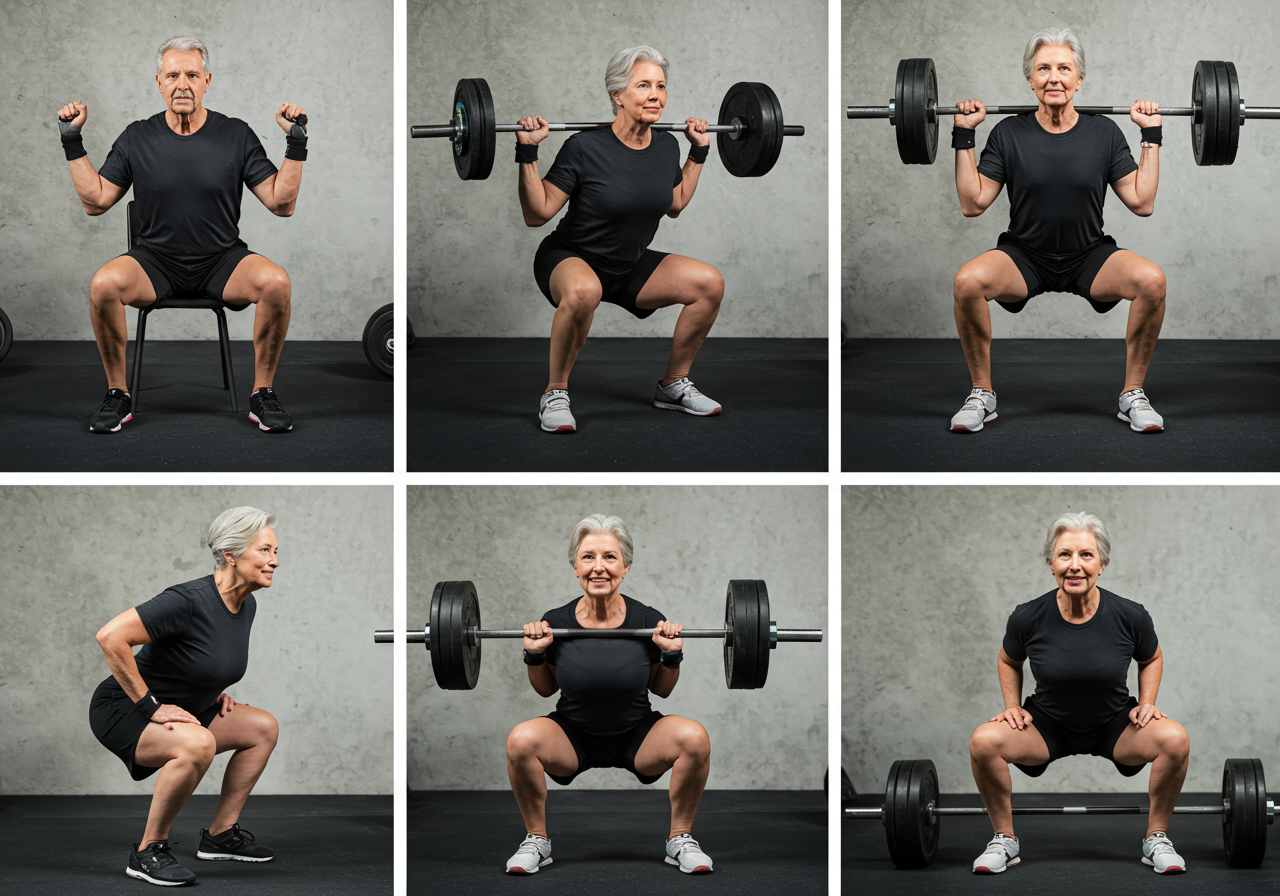
Squat pattern: Box sit-to-stand or goblet squat (use a chair height that feels safe). Exhale while standing.
Hinge pattern: Dumbbell RDL with shallow range or cable pull-through. Keep the spine long and move at the hips.
Push: Machine chest press or wall/bench push-up. Keep elbows at ~45°. Slow down the lowering phase.
Pull: Seated row machine or band row. Squeeze shoulder blades toward the back pockets.
Calf/step: Calf raises holding support, or low step-ups with handrail as needed.
Sets, reps, rest: Start with 2 sets of 8–12 reps per movement. Rest 60–90 seconds. Stop 2–3 reps before form breaks (RPE 5–7). If pain appears, reduce range or load immediately.
Cooldown — 3–5 minutes: Slow walk and gentle stretches for hips, chest, and calves. Easy nasal breathing returns heart rate to baseline.
Breathing & bracing: Inhale through the nose before the effort, exhale during the harder part. Avoid breath-holding unless cleared by your doctor and coached to do so. For blood pressure concerns, prefer continuous breathing.
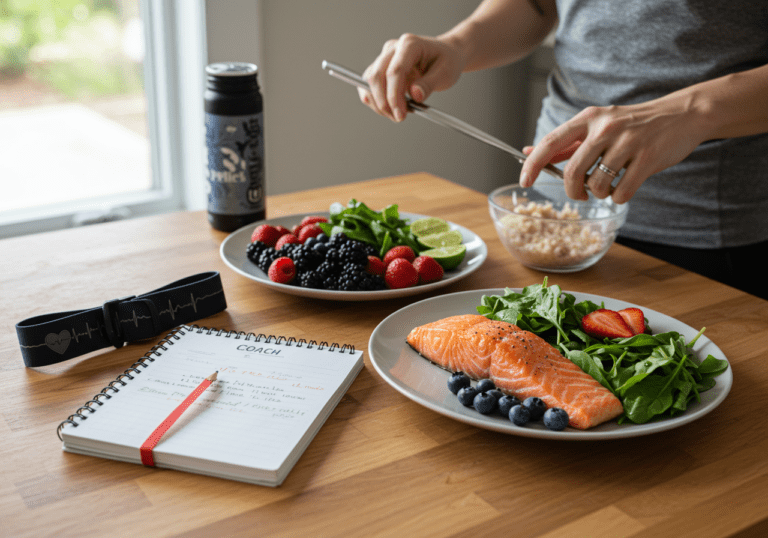
Tech and tracking: I log sessions in Google Sheets and MyFitnessPal for protein intake. Clients often use Garmin/Apple Watch for heart rate. For strength sets, an average heart rate in 90–115 bpm is typical; short carries may spike to 120–130 bpm. We also record session RPE (0–10 scale) and notes like knee comfort or grip fatigue.
Sample real session (45 minutes): Marta (68) — average HR 108 bpm (Zone 2–3 on Garmin); Goblet squat 10 kg 3×8 (RPE 6); Seated row 25 kg 3×10 (RPE 6); Machine press 12.5 kg 3×8 (RPE 6–7); Suitcase carry 14 kg × 3 × 25 m; Calf raises bodyweight × 2 × 12; Felt steadier by set two and finished with easy walk cooldown.
Plain‑text table: 12‑week example progression; select the track that fits your current level. All sets should feel controlled, pain‑free, and end with 1–3 reps in reserve.
Beginner Weeks 1–4: 2 sessions/week; 2×8–10 each lift @ RPE 5–6; box sit‑to‑stand, light DB hinge, machine press/row; carries 2×20–30 m; add 1–2 kg when all sets feel easy.
Beginner Weeks 5–8: 2–3 sessions/week; 3×8–10 @ RPE 6–7; progress to goblet squat and band row; carries 3×25–30 m; add a third lower‑body set if recovery is good.
Beginner Weeks 9–12: 3 sessions/week; 3×10–12 @ RPE 6–7; introduce step‑ups and cable pull‑through; carries 3×30–40 m; increase range before load.
Intermediate Weeks 1–4: 3 sessions/week; 3×6–8 @ RPE 6–7; goblet squat, DB RDL, machine press/row, step‑ups; carries 3×30 m; add 2–4% load weekly if technique holds.
Intermediate Weeks 5–8: 3 sessions/week; 3×8–10 @ RPE 7; optional trap‑bar deadlift light; push‑up on bench; one unilateral move each day; carries 4×30–40 m.
Intermediate Weeks 9–12: 3 sessions/week; 3×6–8 main lifts + 1 back‑off set of 12 @ RPE 6; tempo lowers (3 s) on first set; deload in Week 12 (halve sets).
Advanced Weeks 1–4: 3 sessions/week; 4×5–6 @ RPE 7 on two main patterns (trap‑bar pull, goblet/front squat if comfortable); accessories 2×10–12; carries 4×40 m; rotate grips/handles.
Advanced Weeks 5–8: 3 sessions/week; micro‑load 1–2% weekly; wave sets 5‑4‑3 @ RPE 7–8 on main lift; supersets for accessories; include one power move (med‑ball chest pass) if cleared.
Functional checkpoints (every 4 weeks): 30‑second sit‑to‑stand reps, 30‑meter timed carry weight, comfortable step height, and how stairs/chores feel. If any metric stalls for two checks, reduce volume for one week, then resume.
Frequency & split: Most thrive on 2–3 full‑body sessions per week with at least one rest day between. Keep walks or easy cycling on off‑days for circulation.
Intensity guardrails: Use RPE 5–7 for most sets. If blood pressure is a concern, emphasize continuous breathing and avoid grinding reps. Pain above a 3/10 or sharpness means stop and modify.
Common fixes:
Plateau: Add one back‑off set at lighter load, switch grip/stance, or insert a deload week. Often, more sleep solves more than more sets.
Overuse twinges: Shorten range, slow tempo, and reduce total sets by 25–40% for 7–10 days. Keep moving with low‑impact cardio.
Motivation dips: Pair training with a favorite podcast and schedule with a friend. I also set 20‑minute “minimums” to keep momentum.
Recovery & nutrition: Aim for 1.2–1.6 g protein/kg bodyweight daily (higher end if appetite allows). Spread protein over 3–4 meals. Creatine monohydrate 3–5 g/day is well‑studied; discuss with your clinician if you take medications. Hydrate and target 7–9 hours of sleep. I track protein in MyFitnessPal and bedtime in a simple sleep log.
Medical & safety: If you have unmanaged hypertension, recent surgery, or new chest pain, seek medical clearance first. Use stable machines or sturdy supports early on. Elevate handles, raise boxes, and use straps or thicker handles if grip is a limiter.
Next steps: Reassess your sit‑to‑stand and carry metrics every four weeks, adjust loads by 2–4% when sessions feel easy, and celebrate each small win. Want my printable tracker and video cues? Subscribe and I’ll send the template I use with clients.
Build Sustainable Speed with Weekly Threshold Sessions Tempo runs are my most reliable tool for lifting sustained race pace without feeling wrecked. If you’re new to structured training, this guide shows you exactly how to build, progress, and measure tempos for safer, faster results. Direct answer: Run 15–30 minutes at comfortably hard threshold once weekly,…
Mobility drills prepare joints for better performance Mobility warm-up sets your joints and nervous system for better movement, strength, and cardio performance. Quick answer: pair short mobility drills with activation, then rehearse the day’s pattern. In a few minutes, you will learn an easy sequence I use with new clients: breathing reset, joint prep, mobility–activation…
Start Strong Cycling Workout Plan for Endurance and Power Gains: here’s a simple path to ride longer, push harder, and recover better. Direct answer: Do 3–5 rides weekly—2 base, 1 threshold, 1 power/sprints, plus optional skills; progress volume or intensity every week. In this guide you’ll learn the exact ride types, how to set zones…
Restore T-Spine Extension for Pain-Free Overhead Lifts Thoracic mobility is the hinge that unlocks safe, powerful overhead lifts. In minutes per day, you can restore extension and rotation and protect your shoulders. Quick answer: Combine breath-led drills, end-range loading, and clean scapular mechanics practiced daily for 8–12 minutes. You’ll learn how to assess your T‑spine,…
Master lactate threshold testing and zone-based training systems Lactate threshold is the anchor metric you’ll use to pace, build endurance, and recover smarter. Here you’ll learn how to test it, interpret it, and train around it. Lactate threshold is the fastest steady pace you can hold for 30–60 minutes; train slightly below and just above…
Clear Plan to Restart Stalled Lifts Fast How to break through a strength plateau starts with a clear plan that adjusts volume, recovery, and technique without guessing. You will learn a simple system that gets lifts moving again. Direct answer: Deload briefly, then raise weekly hard sets 10–20% while improving sleep and technique to restart…